Nara Deer Park: The Real Story Behind the Deer, the Crackers and the Rules
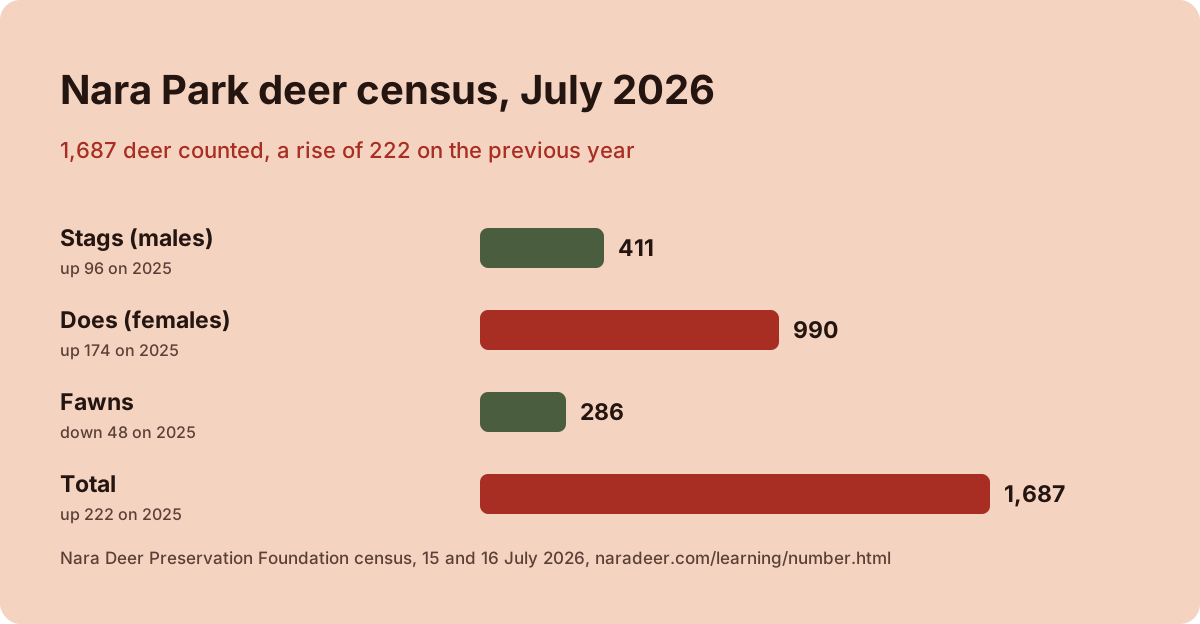
Nara Park is not a petting zoo. The 1,687 sika deer that roam its paths are wild animals, protected as a National Natural Monument, and the Nara Deer Preservation Foundation counts them every July. The latest census, completed on 15 and 16 July 2026, recorded the highest population the foundation has seen in recent years: 411 stags, 990 does and 286 fawns, up 222 on the year before. Here is what every visitor needs to know before they buy a packet of crackers.
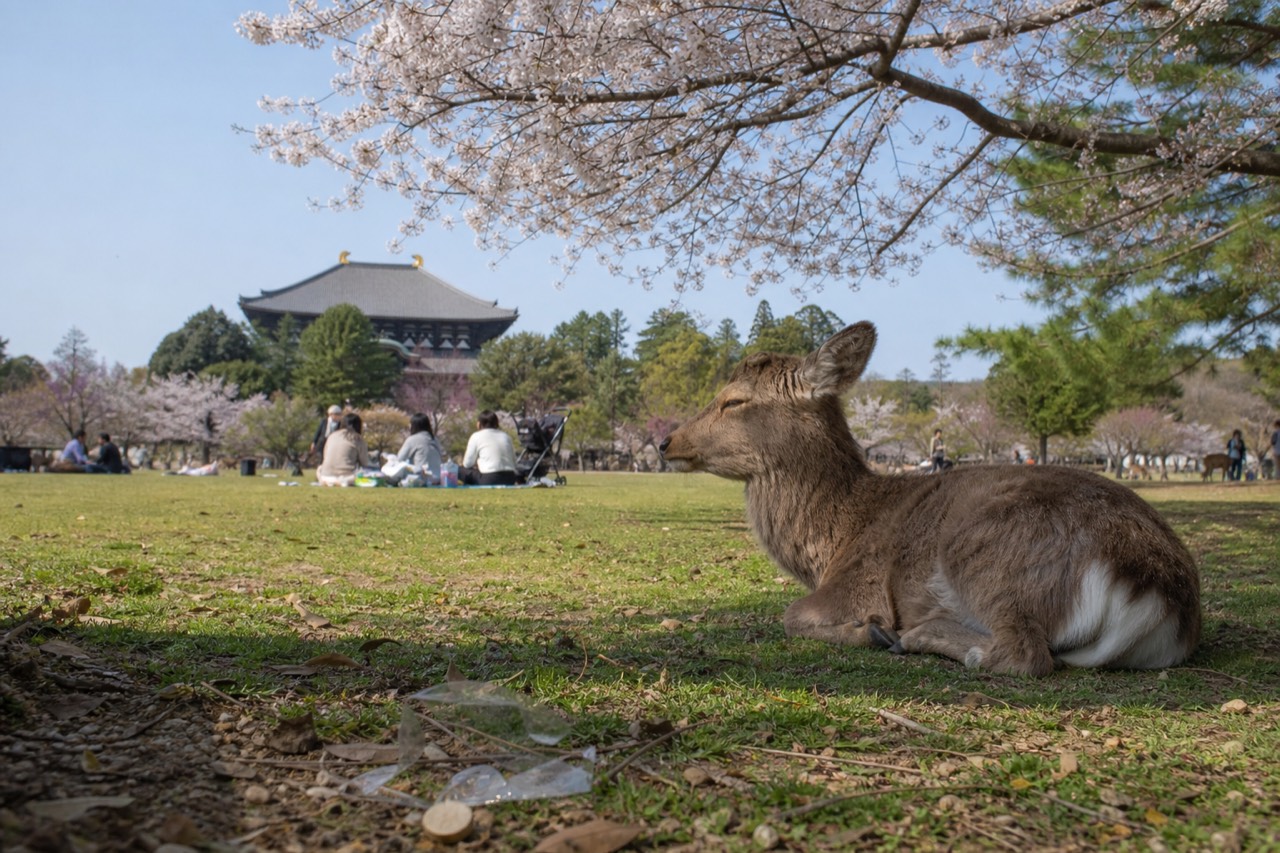
Short answer
Nara Deer Park is home to a wild population of 1,687 sika deer, counted in July 2026 by the Nara Deer Preservation Foundation. The deer are a protected Natural Monument, not a petting zoo. Visitors buy special crackers (about 200 yen) to feed them, but must follow safety rules, especially during the rut (September to November) and calving (May to June) seasons.
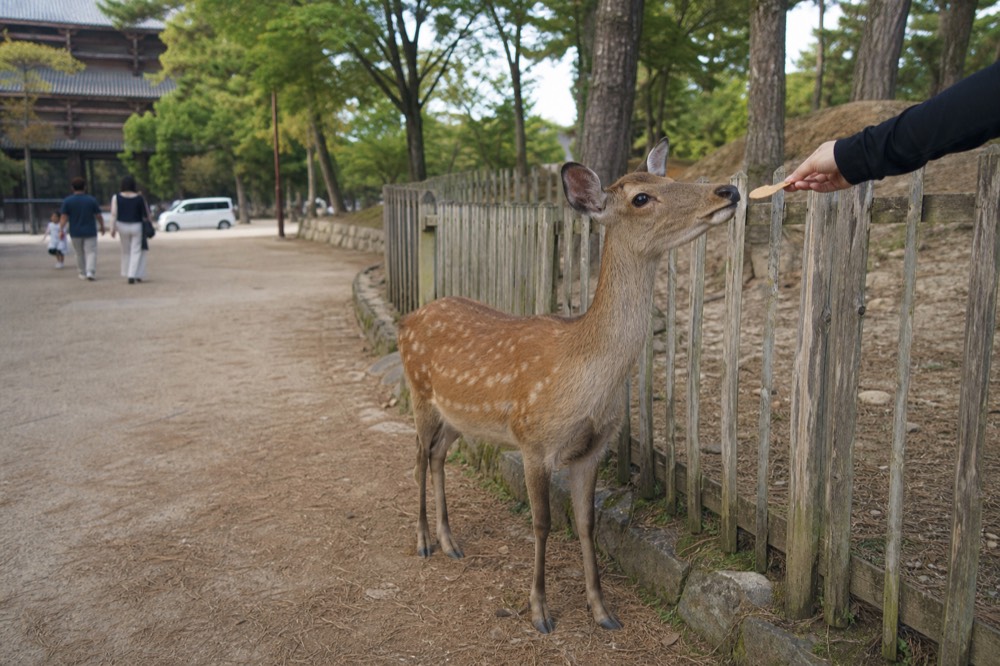
How many deer live in Nara Park?
The July 2026 census by the Nara Deer Preservation Foundation recorded 1,687 deer in Nara Park: 411 stags, 990 does and 286 fawns, a rise of 222 animals on the previous year and the highest total the foundation has published in recent years.
Every summer, foundation staff and volunteers walk the park in the early morning, counting every deer they see. The 2026 survey ran from 05:30 to 08:00 on 15 and 16 July, with help from Kasuga Taisha, Nara Prefecture and three local universities. The count is the official number used by the city, the prefecture and every guidebook that bothers to check.
The figure matters because it shows a population that has grown sharply. The year-on-year jump of 222 animals was driven mostly by a rise in does (up 174) and stags (up 96), while fawn numbers actually fell by 48. The foundation does not publish a long-run chart on its English pages, but the 2026 total is plainly the largest the census has recorded in the current run of data.
The deer are sika (Cervus nippon), the same species found across Japan, but the Nara population is genetically distinct after centuries of isolation. They are designated a National Natural Monument under the name “Nara no Shika,” a status that gives them legal protection. The foundation itself traces its roots to the Kasuga Shinroku Hogokai and was formally incorporated in 1934.
Deer deaths are also recorded. In the financial year to March 2026, 140 deer died. Road accidents claimed 36, disease 30, and the remaining 74 were attributed to other causes. Stray dogs and poaching accounted for zero. Stags made up 30 of the deaths, does 41 and fawns 69.
| Group | 2026 count | Change on 2025 |
|---|---|---|
| Stags (males) | 411 | +96 |
| Does (females) | 990 | +174 |
| Fawns | 286 | -48 |
| Total | 1,687 | +222 |
The foundation’s own figures, published at naradeer.com/learning/number.html, are the only ones that matter. Any other number you see on a travel blog is either outdated or invented. The census is a real, repeatable exercise, and the 2026 result is the freshest hard data on this page.
What are the deer crackers for, and what are they not?
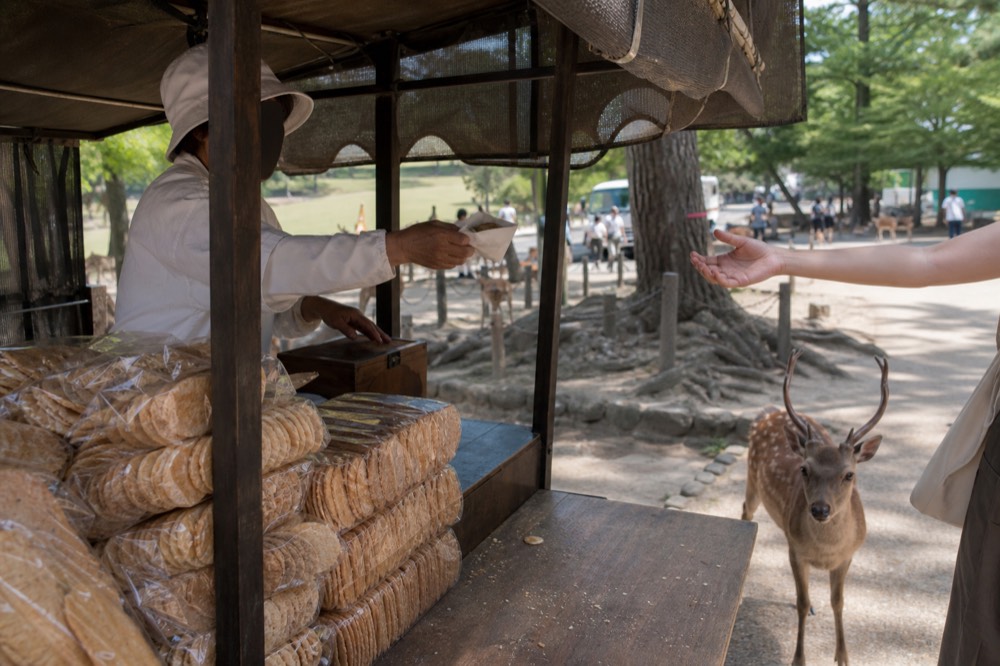
Shika senbei are the only food visitors may give the deer. Sold for about 200 yen a bundle, the crackers are made from rice bran and wheat flour, and the proceeds support the foundation’s welfare work. They are not a treat for the deer to snack on all day: most of the deer’s diet is wild grass and acorns.
The crackers exist for one reason: to give visitors a safe, controlled way to interact with the deer while funding the foundation that protects them. The foundation licenses their production and sale, and the roughly 200 yen you hand over at a park stall goes straight into deer welfare, medical care and the annual census.
A bundle contains about ten crackers. The ingredients are simple, with no sugar, salt or flavourings, because the crackers are designed to be harmless in small quantities. Deer that eat too many crackers or are fed human snacks develop digestive problems, and the foundation is explicit: feed nothing except shika senbei.
The deer do not depend on crackers. Nara Park covers a large area of woodland and grassland, and the deer graze on wild plants, acorns and fallen leaves. The crackers are a supplement, not a meal. On busy days, especially during cherry blossom season or autumn, crackers can sell out by midday, which tells you how many visitors are feeding them.
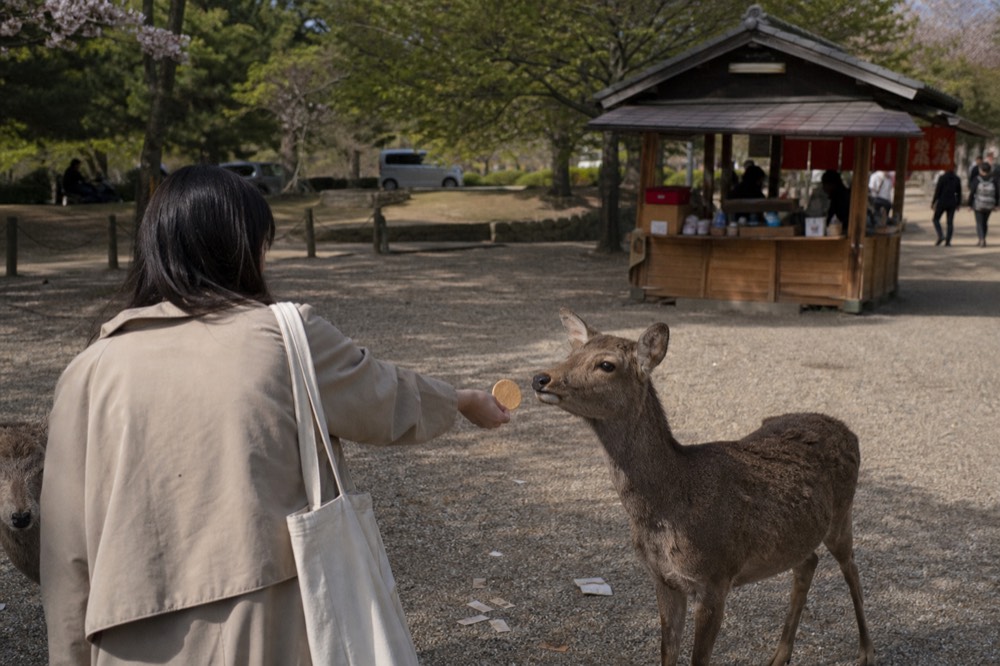
The feeding technique matters. The foundation’s safety guidance, published at naradeer.com/about/keihatsu.html, tells visitors to hand the cracker over quickly, never tease the deer, and never hold the cracker in a closed fist. A deer that thinks you are hiding food will follow you and may press its nose against your hand or bag. If you run out of crackers, show the deer your empty palms and walk away calmly.
| Crackers fact | Detail |
|---|---|
| Price per bundle | About 200 yen |
| Crackers per bundle | Roughly 10 |
| Ingredients | Rice bran, wheat flour (no sugar or salt) |
| Who makes them | Licensed by the Nara Deer Preservation Foundation |
| Where the money goes | Deer welfare, medical care, census work |
| What not to feed | Anything else: no bread, no fruit, no human snacks |
The crackers are not a toy. The deer have learned that the sound of a crinkling packet means food, and they will approach anyone carrying one. If you do not want to be mobbed, keep the crackers out of sight until you are ready to feed, and do not wave the packet around.
When are the deer most dangerous? The two caution months
The foundation designates June and November as official deer-protection months. Calving runs from mid-May through June, when does become aggressive around newborns; the rut runs September to November, when stags charge and butt. Both periods demand extra distance and no teasing.
The Nara deer are habituated to humans, but they are wild. The foundation’s own safety page warns that deer bite, strike, butt and charge, and that older visitors and small children need particular care. The risk is not theoretical: every year, visitors are injured, and the foundation runs multi-language patrols to reduce incidents.
Calving season begins in mid-May and peaks in June. A doe that has just given birth is highly protective. If a visitor approaches a fawn, the mother may charge. The foundation advises staying well away from any fawn lying in the grass, even if it looks abandoned: the mother is usually nearby and will return. The fawn’s instinct is to stay still, and human interference does more harm than good.
The rut, which runs from September through November, is the other high-risk window. Stags become territorial and aggressive. Even stags that have had their antlers removed, a practice the foundation carries out each autumn, can still cause injury by butting or striking with their hooves. The rule is simple: never approach a stag during the rut, and never stand between a stag and a group of does.
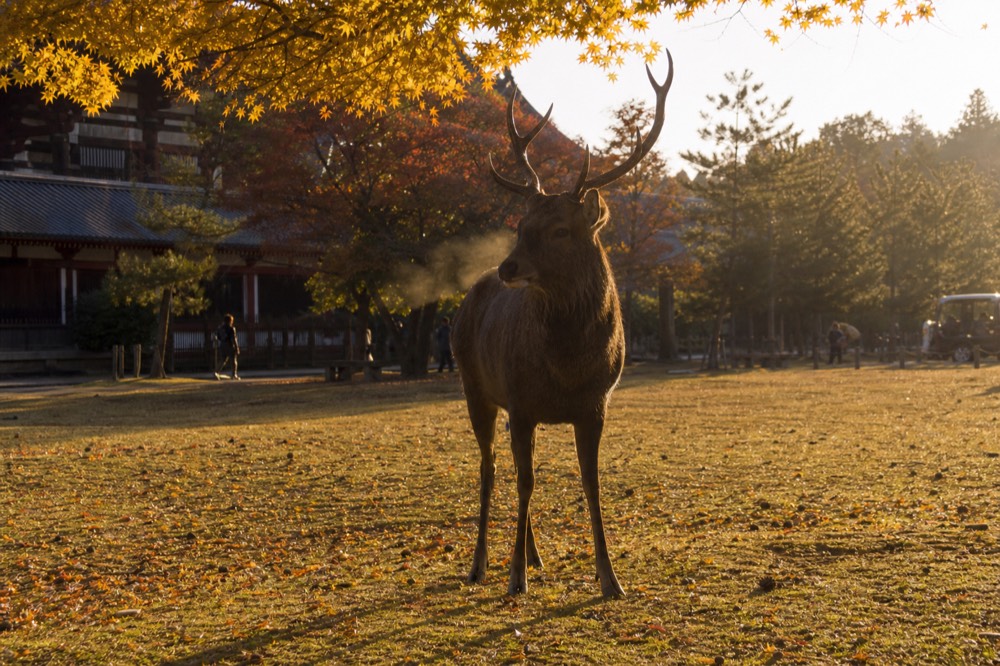
The foundation runs extra patrols during both periods, with signs and pamphlets in Japanese, English and Chinese. The messaging is consistent: keep your distance, do not touch the deer, and follow the four bow rules when feeding. The patrols were stepped up in 2026 after a rise in incidents the previous year, though exact injury numbers are not published by the foundation.
| Period | Months | Behaviour | Visitor risk |
|---|---|---|---|
| Calving | Mid-May to June | Does protect fawns; may charge if approached | High: stay away from fawns |
| Rut | September to November | Stags fight, butt and chase; antlered or not | High: never approach a stag |
| Rest of year | December to April, July to August | Deer generally calmer but still wild | Moderate: bites and shoves still possible |
Joining a guided tour is one way to navigate the park safely, especially during these sensitive periods. The Kyoto and Nara Day Tour includes a licensed English-speaking guide who knows the deer’s behaviour and can help visitors enjoy the park without putting themselves at risk. The tour visits Nara Park as part of a full-day itinerary that also covers Todai-ji and Kasuga Taisha, so you are never wandering the park alone without context.
Do Nara deer really bow? The truth behind the behaviour
The deer lower their heads in a motion that looks like a bow, but it is a learned behaviour, not a sign of respect. Deer that bow are asking for crackers, and the gesture is reinforced by years of visitors rewarding it. The foundation warns that a deer that bows and does not receive a cracker may become pushy or bite.
The “bowing” is a head-dipping motion that deer use to solicit food. It is not a greeting, not a cultural gesture, and not unique to Nara: wild deer in other parts of Japan and in parks overseas do the same thing when they associate humans with food. In Nara, the behaviour has become so common that visitors mistake it for a polite bow, but the foundation’s guidance is clear: it is a demand, not a courtesy.
The mechanism is simple operant conditioning. A deer dips its head, a visitor gives it a cracker, and the behaviour is reinforced. Over decades, the deer that bow most persistently get the most crackers, and the trait spreads through the population. The foundation does not train the deer to bow; the deer trained themselves by watching each other and learning what works.
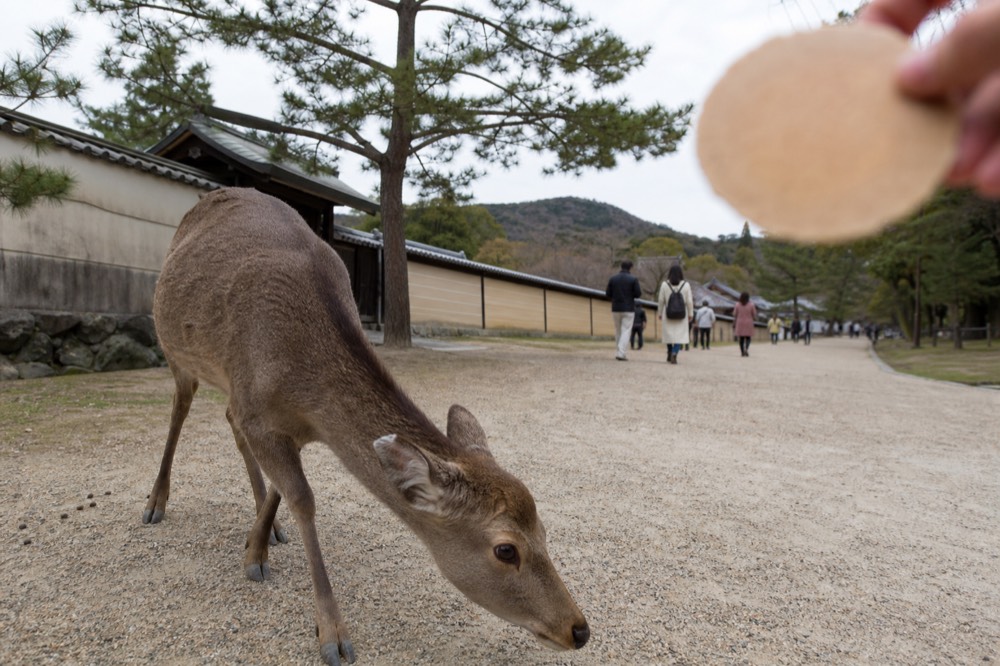
The problem comes when a deer bows and gets nothing. A deer that has learned to associate the bow with food will escalate if the reward does not appear: nudging, nipping, or following the visitor. The foundation’s advice is to bow back if you want, but to hand over the cracker quickly and move on. Do not tease the deer by bowing repeatedly without feeding, and do not encourage children to do so.
The bow is not a sign that the deer is tame. It is a sign that the deer has learned exactly how to extract food from humans, and a hungry, frustrated deer is more likely to bite. The foundation’s safety page lists “do not provoke the deer” as one of its core rules, and teasing a bowing deer counts as provocation.
For a stress-free visit, the Kyoto and Nara Day Tour handles the logistics and includes a guide who can explain deer behaviour as you walk through the park. The tour’s licensed English-speaking guide will show you how to feed the deer safely and what to watch for, so you get the experience without the guesswork.
How to visit Nara Deer Park safely and responsibly
Stay calm, keep your distance, feed only shika senbei, and never touch or chase the deer. The foundation’s four core rules (feed only crackers, hand them over fast, do not tease, and show empty palms when finished) cover most situations, but the most important rule is to remember the deer are wild.
The park is open and free to enter. There are no gates, no tickets and no closing time. The deer roam freely across the paths, the temple grounds and the woodland, and you can encounter them anywhere from the moment you step off the bus or train. That openness is part of the appeal, but it also means there is no barrier between you and a large stag.
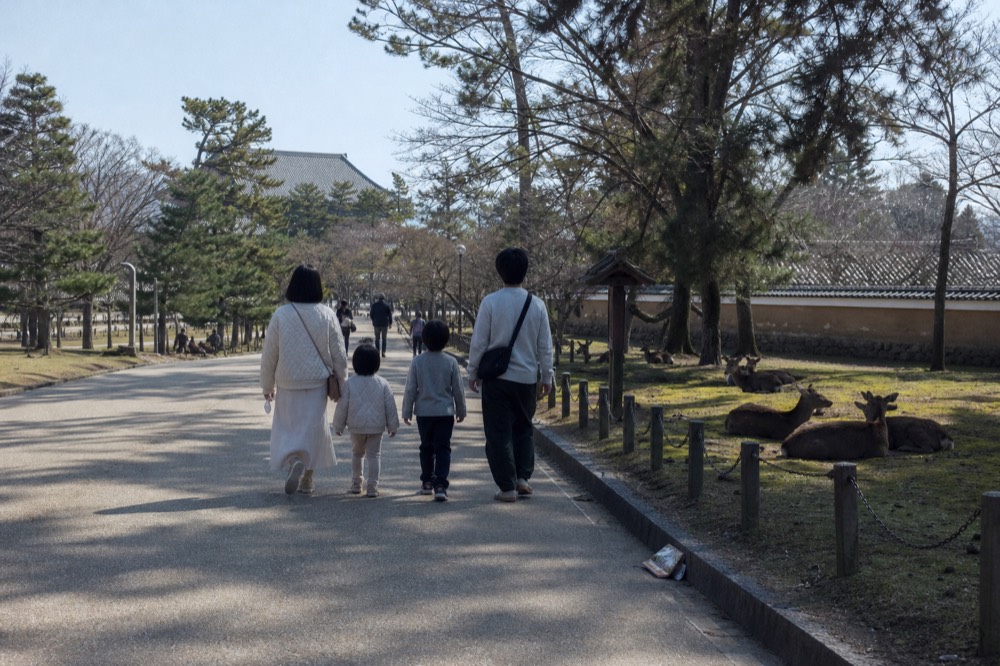
The foundation’s safety guidance is short and practical. Feed nothing except shika senbei. Hand the cracker over quickly: do not hold it in a closed fist. Do not tease the deer by pretending to have food or by bowing without feeding. When the crackers are gone, show the deer your empty palms and walk away. If a deer follows you, do not run; stop, turn your back and move away slowly.
Small children need close supervision. A deer that is eye-level with a child may snatch a cracker from a small hand, and a startled child may scream or run, which can trigger a chase. Older visitors should be aware that deer can knock a person off balance, especially on uneven ground.
| Rule | Why |
|---|---|
| Feed only shika senbei | Other foods harm the deer’s digestion |
| Hand the cracker over fast | Prevents the deer from nipping or following |
| Never tease or provoke | Reduces the risk of bites and charges |
| Show empty palms when done | Signals that feeding is over |
| Do not touch or chase the deer | The deer are wild and may react defensively |
| Keep a safe distance from fawns | Does will charge to protect their young |
| Never approach a stag during the rut | Stags are aggressive and unpredictable |
The park is busiest between 10:00 and 15:00, especially on weekends and during cherry blossom season. If you want a quieter experience, arrive early, around 08:00, when the deer are most active and the cracker stalls are just opening. The light is also better for photography at that hour.
The deer are most numerous around the approach to Todai-ji and the open ground near the Nara National Museum. The further you walk into the wooded areas, the fewer deer you will see, but the ones you do encounter are likely to be shyer and less habituated. The foundation’s patrols are most visible near the main temple route.
If you are visiting as part of a wider Nara day trip, the Nara day trip from Kyoto guide covers the full route, including Todai-ji, Kasuga Taisha and the park. For a comparison of guided options, see the Nara Park tours compared page.
Which Nara Deer Park tour option suits you?
The Kyoto and Nara Day Tour runs daily from Kyoto and Osaka, with six options that differ by departure city and lunch choice. The core itinerary is the same: Nijo Castle, Kinkaku-ji, the Imperial Palace, lunch, then Nara Park, Kasuga Taisha and Todai-ji. The tour includes a licensed English guide, coach transport and all admission fees.
The tour is the only bookable product on Kyoto Nara Day Tour, and it covers both cities in a single day. The Nara portion gives you time to walk from Kasuga Taisha to Todai-ji, feed the deer and take photos. The guide will point out the deer’s behaviour and explain the safety rules, so you do not have to figure them out from a sign.
The six options break down by departure point and lunch. The Kyoto departures meet at 08:20 near Kyoto Station; the Osaka departures meet at 07:15 and end at Osaka Namba, so they do not return to Kyoto. The lunch choices are a Western set, an Indian Thali, or no lunch at all. The no-lunch option is the cheapest and the most flexible: the no-lunch option gives you free time near Kyoto Station instead, so you can grab food there before the coach heads on to Nara.
If you prefer a set meal, the Indian Thali option has drawn the most positive comments from reviewers on the live listing. The Western set is the standard choice and is adequate, but several recent reviews note that the lunch is the weakest part of the day. The no-lunch option lets you skip it entirely and put the saving toward an extra round of crackers.
The Osaka departures suit visitors staying in Osaka who want a single-day round trip without changing hotels. The coach picks up near Namba and returns to the same area, so you avoid the morning train to Kyoto. The journey to Nara from Osaka adds about 30 to 60 minutes each way compared with the Kyoto departure, but the itinerary in Nara itself is unchanged.
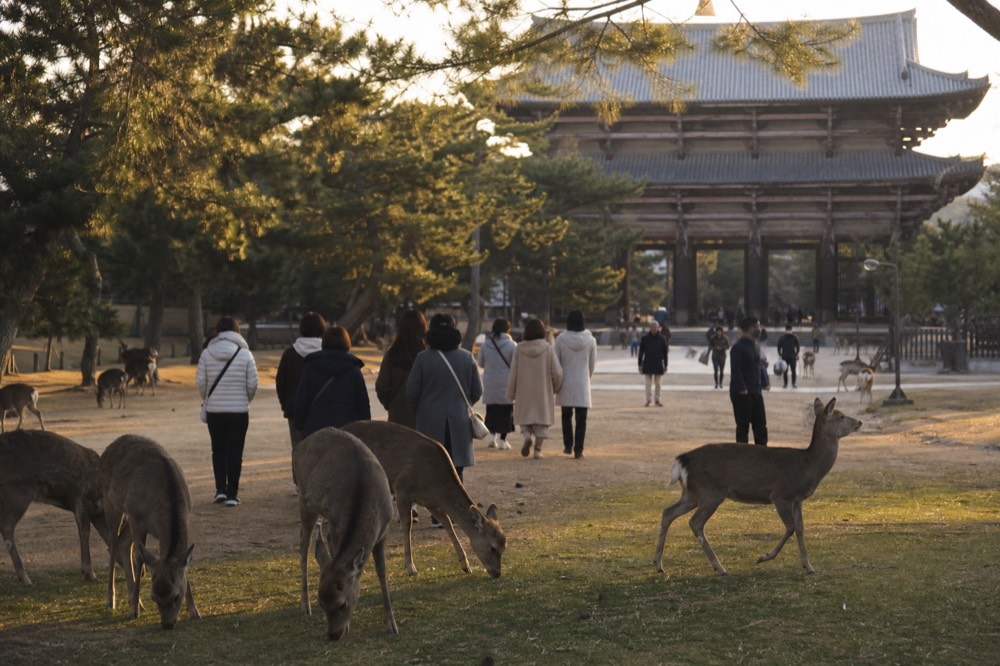
All options include the same Nara Park stop. The guide will walk you through the deer area, explain the feeding rules and give you time to buy crackers. The tour does not rush you through the park: the stop is long enough to see the deer, visit Todai-ji’s Great Buddha Hall and walk the lantern-lined path to Kasuga Taisha.
The tour is rated 4.8 from 32 reviews. The guide quality and the coach comfort are the most praised elements; the lunch is the most criticised. If you want the full experience without the meal, the no-lunch options are the straightforward pick.
What else should you know before you go?
Nara Park is free, but the temples inside it charge admission. Todai-ji’s Daibutsuden costs 800 yen, cash only, and Kofuku-ji’s halls cost 500 to 900 yen each. The deer crackers are sold at stalls around the park for about 200 yen a bundle, and the stalls only take cash.
Cash is still king in Nara. Todai-ji, Kofuku-ji and most cracker stalls do not accept cards or electronic payments. There are 7-Eleven and Japan Post ATMs near Kintetsu Nara Station that take foreign cards, so withdraw cash before you walk into the park. The foundation’s cracker stalls are small wooden booths, often staffed by volunteers, and they sell out quickly on busy days.
The weather matters. Nara’s climate is similar to Kyoto’s: hot and humid in summer, with a mean daily maximum of 33.4°C in August, and cool in winter, with a January mean minimum of 0.8°C. The park has little shade on the open ground near Todai-ji, so bring water and a hat in summer. In winter, the deer grow thicker coats and are less active, but the park is quieter and the light is softer.
The park is busiest during cherry blossom season, which in Nara began on 25 March in 2026, four days earlier than normal. The autumn foliage peak is much later than most visitors expect: Kyoto’s official maple colouring date is 5 December on average, and 2025’s was 10 December. If you are planning a trip around the leaves, November is too early for the full colour.
For more on Nara’s seasons, see the best time to visit Nara guide. If you are still deciding whether Nara is worth the trip, the is Nara worth visiting page lays out the case.
| Practical point | Detail |
|---|---|
| Park entry | Free, open all day |
| Cracker price | About 200 yen, cash only |
| Temple admissions | Todai-ji 800 yen, Kofuku-ji 500–900 yen, cash only |
| Nearest ATMs | 7-Eleven and Japan Post near Kintetsu Nara Station |
| Busiest months | Cherry blossom (late March to early April), autumn (November) |
| Quietest time of day | Before 09:00 and after 16:00 |
The deer are the main draw, but the park is also home to Todai-ji’s Great Buddha, Kasuga Taisha’s lantern-lined paths and the Five-Storied Pagoda of Kofuku-ji, though the pagoda is currently hidden under a steel restoration cover until 2034. The things to do in Nara guide covers the full list.
Common questions about Nara Deer Park
How many deer live in Nara Park?
The July 2026 census recorded 1,687 deer (411 stags, 990 does and 286 fawns), a rise of 222 on the previous year.
Are the Nara deer wild or tame?
The deer are wild sika deer, protected as a National Natural Monument. They are habituated to humans but can bite, charge and butt, especially during the rut and calving seasons.
What are the deer crackers made of?
Shika senbei are made from rice bran and wheat flour, with no sugar or salt. They are the only food visitors may give the deer, and the proceeds support the Nara Deer Preservation Foundation.
Do the Nara deer really bow?
The head-dipping motion is a learned behaviour that deer use to solicit crackers. It is not a sign of respect, and a deer that bows and receives no food may become pushy or bite.
When is the best time to visit Nara Deer Park?
Early morning, around 08:00, offers fewer crowds and more active deer. Cherry blossom season (late March to early April) is beautiful but busy. The rut (September to November) and calving (May to June) require extra caution.
Is Nara Deer Park free?
The park is free and open all day. The temples inside, such as Todai-ji and Kofuku-ji, charge admission, and the deer crackers cost about 200 yen per bundle.